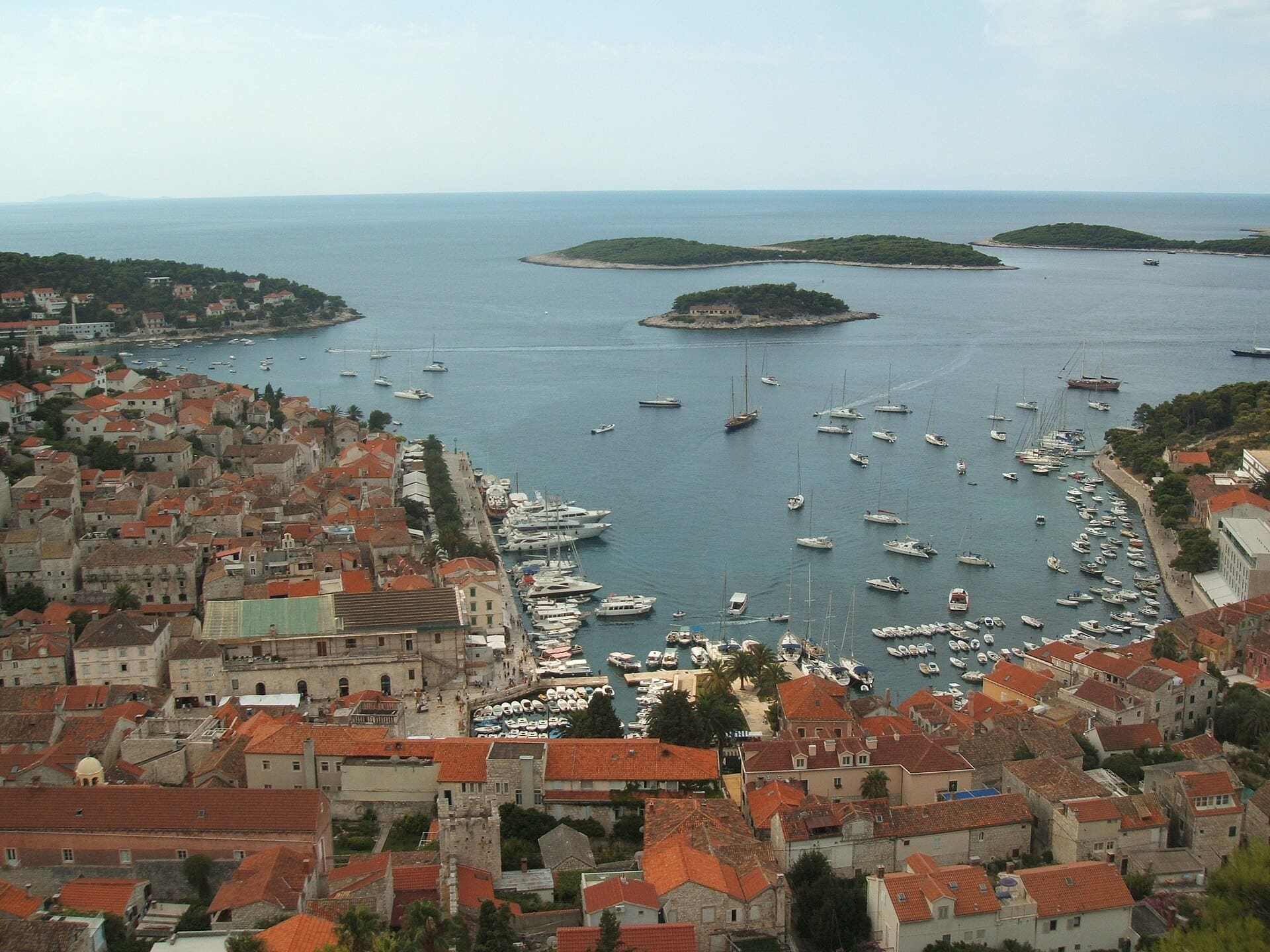
The best swimming near Hvar is not on Hvar. It is a chain of low wooded islands lying across the mouth of Hvar Town’s harbour, beginning under a nautical mile offshore — close enough that water taxis run back and forth all summer for the price of a coffee, and far enough that almost nobody with a car ever reaches them.
They are the reason to come to this part of Dalmatia rather than any other, and they are mentioned in passing by most guides to the island that treat Dubovica as the main event.
The bays, and what each one is
| Bay | What it is | Best for | Facilities |
|---|---|---|---|
| Palmižana | The main bay — marina, restaurants, botanical garden | A first visit, a full day | Full |
| Vinogradišće | The postcard bay on Sveti Klement | Photographs, the classic stop | Some |
| Ždrilca | Shallow, sheltered channel | Families | Minimal |
| Mlini | Shallow, calm, next to Ždrilca | Families, quiet swimming | Minimal |
| Jerolim | Traditionally the naturist island | Quiet, closest to town | Minimal |
| Marinkovac coves | Small unnamed inlets | Escaping everyone | None |
Palmižana — start here
Palmižana sits on Sveti Klement, the largest of the chain, and it is the one bay that functions as a destination rather than a swim stop. There is a marina, a handful of restaurants on the water, a long-established botanical garden planted by the family who have been on the island for generations, and enough shade to sit out a hot afternoon.
Go here first. It is the version of the Pakleni Islands where you can arrive at ten, swim, eat properly, sit in the shade, swim again, and take a boat back at six without having planned anything.
In August the bay is busy by noon and the restaurants want a reservation. It is still the easiest good day available from Hvar Town.
Ždrilca and Mlini — the family answer
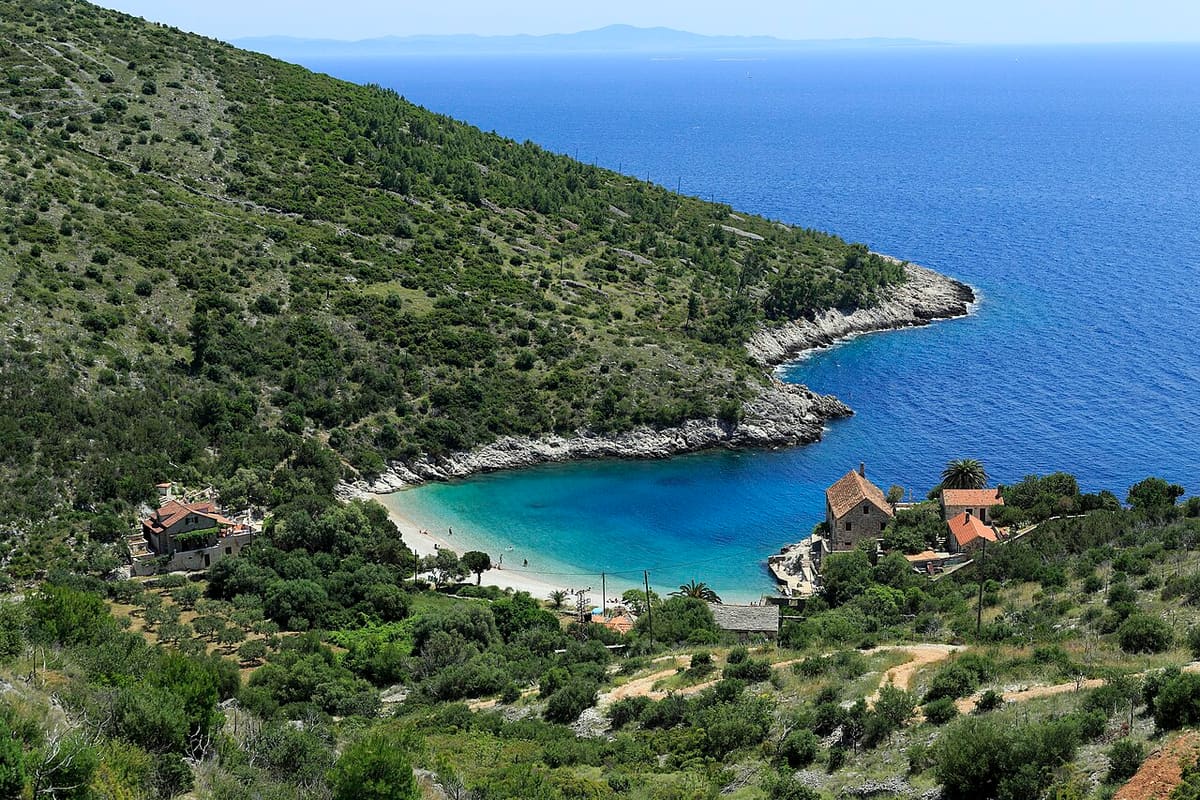
These two sit in the narrow water between Marinkovac and Sveti Klement, and they are shallow, flat and sheltered in a way that very little else around Hvar is.
That matters more than it sounds. Hvar’s own beaches are steep pebble banks dropping quickly into deep water, which is fine for adults and not ideal with a four-year-old. Ždrilca and Mlini are gradual, calm and warm, and the channel between the islands blocks the afternoon wind.
Facilities are minimal — a konoba, not a resort. Bring what you need, go in the morning, and the whole beach problem that dominates a family trip to this island quietly solves itself. The rest of the family case for Hvar is in Hvar with kids.
Vinogradišće — the one you have seen
A broad, bright bay on the south side of Sveti Klement, a short walk over the ridge from Palmižana. It is the bay in the photographs, and it is where the majority of group tours stop, for exactly that reason.
Worth seeing. Not worth planning the day around, because at midday in season it is where everyone else’s tour is also stopping.
Jerolim — the quiet one
The closest islet to Hvar Town and traditionally the naturist island, which is still broadly true and still keeps it quieter than the rest. Rock shelves and small pebble patches rather than a beach, and a ten-minute hop from the harbour.
If you want the Pakleni water with the least effort and the fewest people, this is it.
How to get there
Four ways, in order of how most people should do it.
Water taxi. Boats leave constantly from Hvar Town harbour through the summer, cost a few euros each way, and take ten to twenty minutes depending on the bay. Pick a bay, go, come back when you like. It is the cheapest and most flexible option by a wide margin and the tour market has no reason to advertise it.
A group boat day. Works through several bays with swim stops and a lunch break — more of the chain than you would see independently, on somebody else’s schedule.
A private boat. You choose the coves and the timing, which on water where the good bays fill by eleven is the actual product. Priced per boat, so it lands near a group ticket per head at four people and below it at six.
Driving yourself. Croatian rules allow an adult to operate a boat up to about 5 metres with an engine up to 5 kW without a licence, and the chain is inside the zone Hvar Town operators permit — it is, in fact, the main thing that fleet exists for. A calm-morning plan rather than a guarantee: operators keep the boats in when the wind gets up.
All four are compared properly, with prices, in Hvar boat tours: which one to book. The self-drive rule and what it costs is on our sister site, Adriatic Yacht Guide.
Why the water is better here
Three reasons, and they compound.
No roads. Nothing drains off a road into these bays and no car park empties onto them. The only way in is by boat, which is a filter that Hvar’s own beaches do not have.
No sand. As everywhere on this coast, the bottom is pebble and rock, so nothing gets stirred into suspension. This is the whole explanation for Adriatic water clarity and it is at its most obvious here.
Shelter. The islands sit across the mouth of the harbour, so the coves on their inner sides are protected from the maestral that builds through summer afternoons and roughens the open water. When Hvar’s south coast is choppy at three in the afternoon, Ždrilca is flat.
The timing, which is the only real planning
Morning. Always. The wind builds through the afternoon, the good bays fill between ten and eleven, and the early boat is both calmer and emptier. This single habit is worth more than any choice of bay.
A whole day, not an afternoon. The point of this water is unhurried swimming, and a half-day trip is a transfer with a swim in the middle.
September over June. The Adriatic lags the air by about a month, so the water here is 24–25 °C in September against 21–23 °C in June, and the maestral has weakened. The best Pakleni days of the year are in the first three weeks of September — see Hvar in September.
What to bring
- Water shoes. Pebble and rock, with sea urchins on the shelves. Not optional.
- Shade. The pines help, the bays mostly do not. There is no hire infrastructure outside Palmižana.
- Cash. The smaller konobas are frequently cash-only.
- Water. Facilities are minimal anywhere but Palmižana.
Staying out there
There are a small number of properties on Palmižana, plus the marina. One night is a genuinely memorable thing — the bay after the day boats leave is a different place — and a week is a mistake unless the boat is yours, because the timetable decides when you can move.
If you are weighing it against the mainland options, where to stay on Hvar puts Palmižana alongside every other base on the island and is honest about which ones most people should not pick.
One sentence on the name
You will read that Pakleni means “Islands of Hell”. It almost certainly does not: the accepted explanation is paklina, the pine resin once collected here to waterproof boats. The similarity to pakao has been repeated often enough to become a fact, which it is not.
Where this fits in a Hvar trip
If you have one full day on this island, spend it out here rather than anywhere on it. If you have three, spend one here and read the three-day itinerary for the rest. And if you are deciding between this and the long run west to the Blue Cave, we make that argument in full in is the Blue Cave tour worth it — the short answer being that the Pakleni day is the better day for most people and the cheaper one.