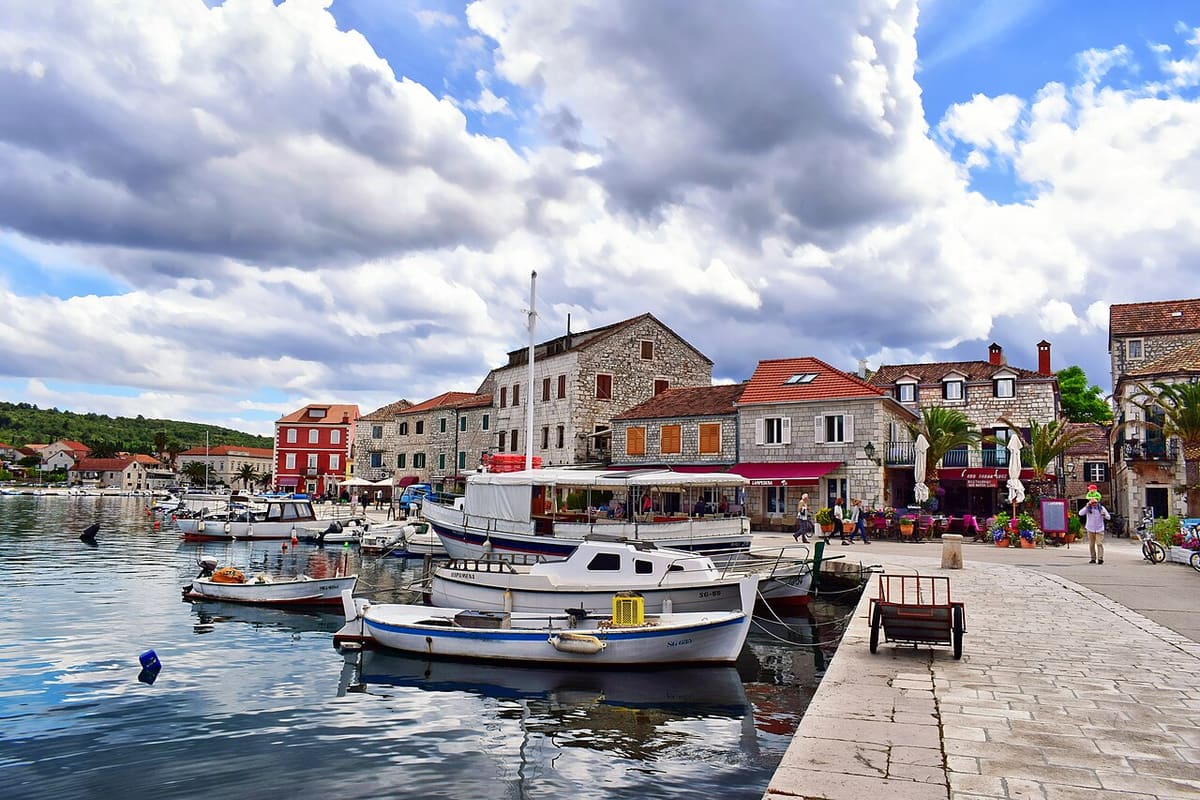
A villa is the best-value way to do Hvar for four or more people, and the listing you book it from will tell you about the infinity pool and nothing about the things that decide whether the week works.
What follows is the checklist that is specific to this island — a steep, dry limestone ridge with two ferry ports on opposite sides and a lot of properties at the end of unmade tracks. Generic villa advice does not cover any of it.
The five questions that actually matter
- Which side of the island is it on? This decides which ferry you need, and the two are not interchangeable.
- How do you get to the water, and on foot or by car?
- Is the water supply mains or a cistern?
- What is the access road?
- What is the total, including every fee?
Everything below is detail on those five.
1. Which side — because it chooses your ferry
The fast catamaran lands foot passengers in Hvar Town. The car ferry lands vehicles in Stari Grad, on the opposite side of the island. The catamaran cannot carry a car and Hvar Town has no car ferry berth.
So a villa on the plain behind Stari Grad and a villa above Hvar Town are two different journeys, and if you book the hire car onto the wrong boat you lose a day. Work out the property’s side of the island before you book any transport, and read the Split to Hvar ferry guide before you book the crossing.
Two consequences people miss:
- The vehicle deck is a separate allocation from the passenger seats and fills earlier — three to four weeks out for August. Foot-passenger availability tells you nothing.
- A villa with parking is useless if you arrive without a car. Check how you are getting from the port to the door. Some properties arrange a transfer; most do not.
2. The water — “by the sea” is doing a lot of work
Hvar is steep. A property can be two hundred metres from the sea and a hundred metres above it, down a path of loose stone in the dark.
Ask three specific things:
- Is it a walk or a drive? And if it is a walk, how long back up, carrying a cool box, at four in the afternoon?
- What kind of water entry? There is no sand anywhere on Hvar. The honest answers are pebble beach, concrete bathing platform, or rock shelf with a ladder. All are fine; they are not the same thing, especially with children or anyone unsteady.
- Is it private, shared or public? A “private beach” in Croatia is almost always a legal impossibility — the coastline is public — so what is meant is usually a platform or a cove that is simply hard for anyone else to reach.
And on the view: ask which rooms have it, and whether a road or another house sits between you and the water. Look for photographs taken from the terrace, not of it.
3. The water supply — the question nobody asks
Hvar has no rivers. It is limestone, it drains straight through, and historically the island ran on rainwater cisterns — you can still see the collection channels cut into the stone on the Stari Grad Plain.
Most villas today are on the mains and this is a non-issue. Some, particularly the remoter ones on the south coast and high on the plain, are still on a cistern or a tanked supply. A house with a pool, three bathrooms, eight people and no rain since May is a genuine load on that.
Just ask: mains or cistern? A good owner will answer plainly and tell you how they manage it. The answer changes nothing most of the time and matters enormously the one time it does.
While you are asking, ask about power. Rural properties on both coasts can have thin supply, and “air-conditioning” sometimes means one unit in the living room.
4. The access road
This is the single most common unpleasant surprise on Hvar, and it concentrates on the south coast and the inland terraces.
- Is the final approach surfaced? Unmade tracks are common and mostly fine — but not in a low hire car, and not reversing in the dark.
- How steep, and how narrow? Passing places matter more than width.
- For the south coast: does the route use the tunnel? The single-lane, partly unlit tunnel through the ridge to Zavala is genuinely narrow. Take it slowly and do not attempt it in anything large.
- Will your hire car cope? If the answer is “a 4x4 is better”, that is a cost and a booking constraint, not a detail.
5. The total, not the nightly rate
Two villas advertised at the same nightly rate can land a long way apart once everything is counted. Ask for the all-in figure for your exact dates and party, and expect some combination of:
- Refundable damage deposit, usually held on a card.
- Final cleaning fee, charged once per stay.
- Croatian tourist tax, per person per night, usually collected at the property.
- Linen and towels, occasionally extra, occasionally extra for a mid-week change.
- Pool heating, which is a real line in May, early June and October — an unheated pool in shoulder season is a water feature.
- Air-conditioning, very occasionally metered.
None of these is large. Together they are worth knowing before you compare.
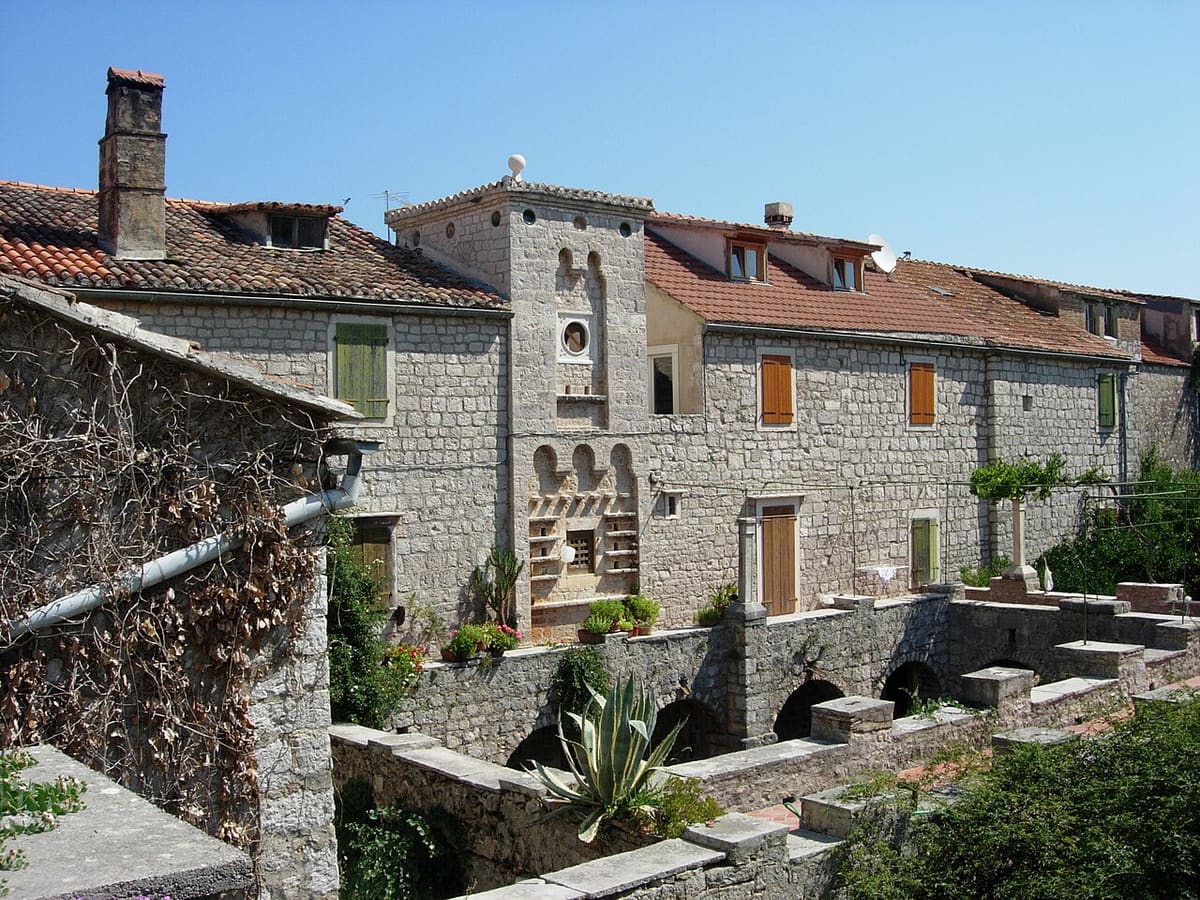
Stari Grad & the north coast
Villas on the Stari Grad plain
The seasonal traps
Saturday to Saturday. In peak season most villas run seven-night minimums on a fixed changeover day, because that is how the cleaning schedule works. If your flights are mid-week in August, that constraint will cut your options harder than your budget will. It relaxes in shoulder season.
The pool in May and October. Unheated outdoor pools on Hvar are cold in both. Ask whether heating exists and what it costs — see Hvar in May and Hvar in October for what the shoulder months are actually like.
Shade. Hvar in July and August is relentless. A terrace with no pergola, no awning and no tree is unusable between eleven and five, which removes the main reason you booked a house with a terrace.
Provisioning. A villa’s kitchen is most of its financial advantage, and it only works if there is a real shop you can reach. Ask where the nearest proper supermarket is, not the nearest shop — a village mini-market will not stock a week for eight people.
When to book, and the cancellation question
Villa stock on Hvar is small in a way that hotel stock is not: these are individual houses, most let by one family, each with maybe fifteen weeks a year that anybody wants. So the lead time is long and being late costs you the property rather than the price.
- June to September: three to four months.
- First fortnight of August: five to six months.
- Shoulder season: six to eight weeks is comfortable.
Booking that far ahead makes the cancellation terms a real term rather than boilerplate. A deposit taken in February against a week in August is money committed for six months. Read what happens if you cancel, and at what notice — and if a property is advertising an early-booking discount of 10–30%, check whether taking it also tightens those terms.
The full ordering for every part of a Hvar trip is in when to book everything for Hvar.
Is a villa right for you at all?
Be honest about the arithmetic. A villa at €390–520 a night is the efficient choice for four or more people: divided by heads it lands near mid-range, and the kitchen removes the food premium that dominates a Hvar budget. The numbers are set out in what a week on Hvar actually costs.
For two people it is poor value and worse placed. An apartment in Stari Grad or a boutique hotel room on the Hvar Town harbour costs less and puts you where you want to be in the evening.
Which base to aim at in the first place is the prior question, and it is covered in where to stay on Hvar — every option on the island, what each costs relative to Hvar Town, and who it suits.
One worked example
We profile one property in detail rather than pretending to have stayed in many: Heritage Villa Apolon in Stari Grad, assessed on position, logistics and what guests consistently report across seasons. It is a useful model for how to read any listing on this island — what the position actually gives you, and what the rate is really buying.